Wanderlust Ice & Ink — Travel: Milano Olympic Games, Five Facts from the Figure Skating Men’s Free Program And The Coronation of Mikhail Shaidorov


Wanderlust Ice & Ink — Travel: Living the Olympic Experience in Milan, Five Facts from the Men’s Short Program. (c) Sarah B

From early shocks to late reversals, the Olympic order unraveled under pressure, leading to one of the biggest plot twists in the sport’s modern history. Men’s Free Skate at Milano Cortina 2026 did not unfold as a predictable Olympic final but as a live dismantling of the competitive hierarchy, where what was expected to confirm dominance instead exposed fragility. From the first skaters, the tension inside the arena felt different, this was not a night where reputation guaranteed stability but one where execution alone determined survival. The hierarchy began collapsing long before the favorites took the ice, as early performances disrupted projected standings and clean skates from outsiders shifted the pressure upward, forcing the leaders into defense rather than confident pursuit. Milano Cortina 2026 revealed an essential Olympic truth, standings remain provisional until the final blade mark, and programs that defined the season can become vulnerable under the weight of expectation. As the event progressed, the atmosphere transformed, every fall echoed louder than expected, every clean landing drew a collective breath from the crowd, and the competition lost its linear logic, becoming volatile, unpredictable, alive. In stark contrast to pre event projections, Ilia Malinin’s free skate became an anatomy of Olympic pressure, as the leader after the short program saw his campaign unravel under expectation. Beyond the final flight, Shun Sato and Petr Gumennik delivered decisive performances that reshaped the podium, while Canada’s Stephen Gogolev produced one of the most remarkable skates of the night to place second in the free program, an achievement that received far less attention than its significance deserved. Within this instability, one performance stood apart for its clarity and control, as Mikhail Shaidorov did not chase gold but outlasted the collapse around him, transforming composure into victory and securing a historic result for Kazakhstan. The night did not belong to the skater who imposed himself on the field, but to the one who remained intact as the field fractured, and Milano Cortina 2026 will be remembered as the moment the Olympic order broke and a new geography of men’s figure skating emerged. Here in this article are five facts about the men’s free program, the competition that concluded the Olympic event, revealed its final result, and delivered one of the most extraordinary plot twists in the evolving identity of modern figure skating.
 WII MEN FREE OLYMPIC .mp3 (3.05 Mo)
Fact 1 — An Electric Arena, How the Free Skate Shatters Hierarchy Before the Final Flight

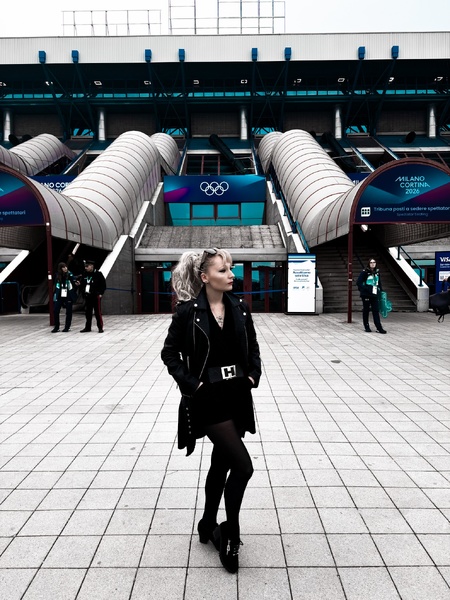
The men’s free skate is the long program, the segment where the event is truly decided. Unlike the short program, which is built around a fixed set of required elements and a tighter time window, the free program follows ISU regulations that allow skaters to construct a layout of up to seven jump elements, including multiple quadruple jumps, three spins, a step sequence, and a choreographic sequence within a program lasting four minutes. This structure transforms the segment into a longer test of endurance, structure, and risk management, where skaters attempt their full technical identity and reveal the true scale of their competitive ambition. The freedom of layout construction means athletes must balance base value with execution quality, repetition rules, and energy distribution, knowing that jump combinations, second half bonus values, and quad placement can dramatically influence scoring potential. This is the part of the competition where quad volume, late program fatigue, jump repetition limits, and the ability to protect execution under pressure can completely reshape the standings.
Over four minutes, physical endurance, cardiovascular capacity, and mental focus become inseparable from technique, and the difficulty of maintaining edge quality, rotation speed, and landing control increases with each passing element. Under ISU rules, jumps performed in the second half of the program receive a ten percent base value bonus, encouraging skaters to place their most difficult elements late in the layout, precisely when fatigue and pressure are highest. A short program hierarchy can look logical, even stable, but the free program exposes what holds over time, it punishes small breakdowns, it magnifies errors through cumulative value loss, and it rewards the skater who can keep the hardest layout intact across the full duration. Under rotations reduce base value, negative grades of execution multiply point loss, missed combinations eliminate entire scoring opportunities, and fatigue late in the program can compromise jumps that would be routine earlier in the skate. Repetition rules further limit recovery options, meaning a failed quad cannot always be replaced later without penalty, and the mathematical balance of the program can shift instantly.
This scoring structure means that a single mistake rarely remains isolated, it cascades through the layout and alters the technical and component balance of the program. Olympic pressure intensifies this dynamic, as the awareness of consequence affects timing, takeoff confidence, and risk decisions in real time. This is why Olympic titles are rarely decided by reputation, and why the free skate can fracture an entire hierarchy in real time, transforming projected podiums into unstable territory and forcing even dominant skaters to fight for survival rather than confirmation.
Now, the men’s free skate in Milan did not begin with the final group. It began with pressure, noise, and instability from the very first skater. The atmosphere inside the arena reflected the nature of the segment itself, cumulative tension, immediate consequences, and the understanding that every performance could reshape the standings long before the medal contenders took the ice. This aligns with how the free skate overturns placements through cumulative risk, repetition constraints, and late program breakdown, and with how Olympic pressure can transform dominance into vulnerability, making the event less a procession of favorites and more a prolonged test of resilience. The standings after the short program were tight, and quad heavy layouts across the field meant placements could change quickly. Coaches knew it. Skaters knew it. The audience felt it. There was no safe ranking, no buffer, no guaranteed trajectory. Every program had the potential to reshape the standings. From the very first skaters, the reaction pattern inside the arena was immediate and intense. Clean landings triggered sharp applause. Step outs and under rotations produced audible gasps. The crowd was not politely observing, it was reacting in real time, and that reaction increased the pressure on every athlete who followed. The judging panel set the tone early. Under rotations were called. Edge issues were marked. Incomplete combinations were not overlooked. Base value alone would not protect anyone. Execution would decide everything.
Fact 2 — The First Groups That Set the Tone and The Fight Started Before the Favorites Even Touched the Ice

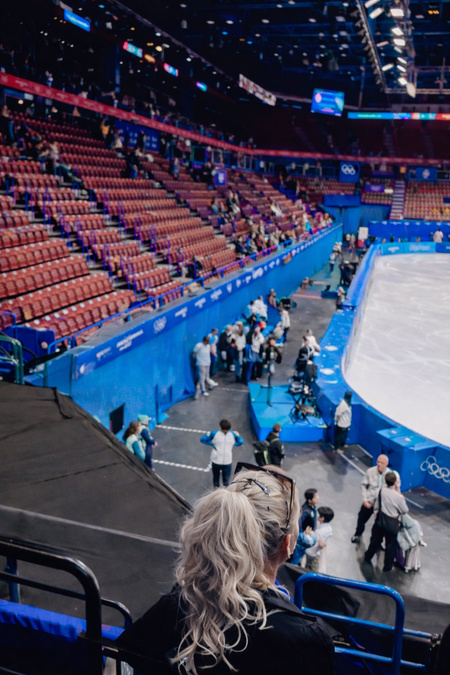
Donovan Carrillo set the emotional tone of the night. Representing Mexico on one of the sport’s biggest stages, he brought speed, musical phrasing, and an immediate connection with the audience that produced one of the first major reactions inside the arena. His components reflected strong presentation and performance quality, and his skate affirmed that Olympic figure skating is also about identity, cultural visibility, and projection. The protocols showed how his performance quality resonated while the technical base value defined placement in a quad driven field.
Edward Appleby followed with a disciplined and controlled program built on clean edges, measured pacing, and secure execution. His score reflected the value of precision and composure, reinforcing that judges rewarded clarity of skating and well managed elements even in a technically escalating field.
Vladimir Samoilov delivered a structured layout emphasizing endurance and control. His program demonstrated strategic construction and reliable execution, and the judging reflected how stability and clean landings contribute to a cohesive technical score in a demanding Olympic environment.
Adam Hagara brought youthful ambition and technical intent to the ice. As a young Slovak competitor stepping onto the Olympic stage, his performance represented the emergence of new skating nations and the next generation of athletes entering the quad era with confidence. His score reflected both his ambition and the technical demands of the field.
Yu Hsiang Li represented Chinese Taipei with determination and focus. His program showed commitment to complex content, and the scoring illustrated how even small technical calls carry weight under Olympic judging standards. His presence highlighted the expanding global reach of elite figure skating.
Kyrylo Marsak skated with visible commitment and national pride, representing Ukraine on the Olympic stage. His ambitious layout reflected competitive courage, and the audience responded to his determination. His performance illustrated how Olympic skating carries meaning beyond the technical sheet.
Maxim Naumov brought emotional depth to the ice. Skating in the wake of profound personal loss after the passing of both his parents the previous year, he carried their legacy with him in every element. His program combined technical intent with visible composure, and the judges’ scores reflected a performance held together with focus and resilience. His skate resonated as a testament to perseverance within the Olympic arena. By this stage, the atmosphere had already shifted. The arena was louder, reactions sharper, and each performance was shaping the psychological climate of the event.
Boyang Jin brought veteran authority and quad attempts that electrified the arena. A pioneer of the quad revolution and a central figure in Chinese men’s skating history, his attempts raised the energy inside the building. His technical content and base value reflected the enduring influence of his jumping legacy.
Deniss Vasiļjevs emphasized skating skills, flow, and interpretation. A longtime student of Stéphane Lambiel, he represents the artistic lineage of modern skating. His component scores reflected the judges’ recognition of quality edges, musicality, and choreographic cohesion, reaffirming that artistry remains integral to Olympic skating identity.
Matteo Rizzo, skating in front of a home crowd, embodied the emotional intensity of competing on home ice. As one of Italy’s leading men’s skaters, his performance carried national pride and collective expectation. His score reflected a balance of technical content and performance quality, and the audience response underscored the connection between athlete and nation.
Andrew Torgashev delivered a technically solid performance marked by resilience and rebuilding. Returning to major championships after challenging seasons, his clean combinations and controlled elements demonstrated competitive maturity. His score reflected the value of consistency in an unstable field.
Kevin Aymoz brought emotional projection and performance quality that resonated strongly with the audience. Known for his expressive style, he drew visible engagement from the crowd. His component marks reflected the strength of his interpretation and skating skills, reinforcing the expressive dimension of Olympic skating.
Nika Egadze delivered an ambitious quad heavy layout with visible determination. Training within a high performance system and representing Georgia, his technical content reflected the evolving ambition of the next generation. His score demonstrated how difficulty and commitment contribute to upward mobility in a volatile standings environment.
At this point, the arena had stopped feeling like an audience. It felt like an active participant. Reactions were immediate. Applause was sharp. Gasps were loud. The pressure inside the building was tangible.
Every skater entering the ice now faced a different environment than the first. The noise was louder. The expectations were higher. The margin for error felt smaller. The ice did not change, but the psychological climate did.
The Reemergence of Stephen Gogolev’s Technical Identity and Olympic Reaffirmation
Shortly after, Stephen Gogolev reinforced that reality, and the protocols explain why his second place finish in the free skate should not be treated as a random surprise, even if much of the public narrative framed it that way. Gogolev has always been a skater built around exceptional technical potential, a junior prodigy, a Junior Grand Prix Final champion, a skater who set multiple junior world record scores, and was widely noted early for landing difficult quads at a very young age, including being described as the youngest to land three quadruple jumps, before injuries and a major growth spurt disrupted his trajectory for several seasons. What happened in Milan reads less like a fluke and more like the reappearance of that original profile, a high risk jumper with the capacity to deliver elite technical content when the body holds and the mind stays clear.
On paper, his free skate is built like a serious technical statement, not a lucky skate, a clean four salchow, a clean four toe, then a four salchow plus three toe combination early, meaning he established quad credibility before fatigue could distort timing. He then backed it with structure rather than survival skating, a choreographic sequence that stayed connected, a triple axel plus one euler plus triple salchow, then later a triple flip plus triple axel sequence in the bonus half, meaning he still attacked difficulty deep into the program instead of protecting a lead. The details matter because they show control of pacing, he was not front loading everything and hoping to hang on, he was sustaining threat across the layout. His technical numbers confirm it. He finished with a total element score of 103.22 with no deductions, and his base value was already high at 88.51 before grades of execution pushed it upward, which places the skate among the most technically valuable of the entire event. The combination of clean quads, settled landings, and a program that did not unravel late is exactly the type of free skate profile that can flip an Olympic hierarchy, not by one highlight moment, but by accumulating value across the full four minutes. Just as importantly, his component score was not treated as an afterthought, he received 83.15 in program components, meaning the judges did not score him like a pure jumper surviving on base value, they scored him like a complete competitor who held the program together. In a segment where so many skaters were losing points through cascading errors, his sheet is striking because it stays intact, levels, sequences, and jump structure all remain functional.
That is why his placement should be read as an under discussed fact of the event rather than a curiosity. His second place in the free skate became proof that late surges were not only possible, they were logical when the free skate rewards endurance, layout coherence, and the ability to keep high value elements stable under pressure. The audience reacted with one of the loudest responses of the earlier groups because the arena could feel what the protocols later confirmed, this final was not about reputation, it was about who could keep a quad layout intact when the entire field was tightening.This is the highest finish for a Canadian at the Olympic games in men’s singles since Patrick Chan won silver at the Sochi Olympic Games in 2014.
Turning Point — Petr Gumennik
Sitting 12th after the short program, he had no margin for error. Skating 13th in the free skate, Petr Gumennik delivered one of the most loaded technical layouts of the night, and the protocol makes it obvious why it hit the arena like a warning shot. On paper, it is not simply a quad heavy skate, it is five quad attempts in one free program, 4F, 4Lz, 4Lo, 4S plus 3T, then another 4S in the second half inside a sequence with two double axels. Even with calls that matter, the q markings on both quad salchows, the under rotation on the triple axel, the q on the lutz entry into the two loop, the structure of the program still held, because the volume of difficulty remained intact and the jumping content did not collapse. The scoring sheet shows it clearly, his base value total sits at 96.93 and rises to 103.84 in TES, meaning the technical risk was not only attempted, it was rewarded overall despite the review calls. He scored 184.49 in the free skate and climbed to sixth overall. More importantly, his performance changed the psychology of the event. It demonstrated that placements were fully open, and that a skater outside the top group could still detonate the standings with a free skate built on extreme difficulty. From that moment, every skater understood that one mistake could cost multiple positions, because the bar had been raised by pure math as much as by performance. The arena reacted accordingly. Applause grew louder. Coaches leaned forward at the boards. Skaters backstage watched more closely. The message was clear, the free skate was no longer about holding rank, it was about surviving a field where five quad attempts could come from the middle of the start order and still move the entire event.
The Atmosphere Became Heavy
As more skaters took the ice, tension did not decrease. It intensified. Coaches stood rigid at the boards. Skaters took extra seconds before opening passes. The arena reacted loudly to every jump outcome.
Mistakes now felt heavier. Clean programs felt like survival rather than triumph. The standings remained unstable. The early groups had already proven that placements could shift dramatically.
Some skaters left the ice visibly relieved simply to complete their programs. Others showed frustration after small errors that had immediate scoring consequences. The emotional weight of the event was visible across the field. The perception of strict judging and unforgiving conditions reinforced the tension. Whether it was the ice surface, the lighting, the acoustics, or simply Olympic pressure, the margin for error felt extremely small. By the time the later flights were preparing backstage, the conditions of the event had already been defined. The early skaters had set the tone: strict judging, visible pressure, unstable rankings, and a fight for every position. This final did not begin with the favorites. It began with tension, instability, and the realization that survival mattered more than status. The early groups did not decide the medals. They defined the night. This is how the men’s free skate in Milan truly started: not with hierarchy, not with projections, but with pressure from the very first skate.
Men’s Free Skate — Milano 13 Feb 2026 Total Segment Score + Jump / Quad highlights (per skater)
1 — Mikhail Shaidorov (KAZ) — 198.64
Jump highlights: 3A+1Eu+4S, 4Lz(q), 4T, 4F, 4T+3T, plus 3A and 3Lz+2A+SEQ.
2 — Stephen Gogolev (CAN) — 186.37
Jump highlights: 4S, 4T, 4S+3T, 3A+1Eu+3S, 3F+3A+SEQ, plus 3Lz.
3 — Shun Sato (JPN) — 186.20
Jump highlights: 4Lz, 4T+3T, 4T, plus 3A+1Eu+3S and 3A+2A+SEQ.
4 — Petr Gumennik (AIN) — 184.49
Jump highlights: 4F, 4Lz, 4Lo, 4S+3T, 4S+2A+2A+SEQ, plus a 3A attempt in the second half.
5 — Junhwan Cha (KOR) — 181.20
Jump highlights: a big 4S, a 4T attempt, strong 3Lz+3Lo, and two 3A (solo + sequence).
6 — Yuma Kagiyama (JPN) — 176.99
Jump highlights: 4S, 4F attempt, 4T, 4T+1Eu+2S, plus two 3A and 3F+3Lo.
7 — Nika Egadze (GEO) — 175.16
Jump highlights: 4T, two 4S+3T, plus 3A and 3F+2A+2A+SEQ.
8 — Daniel Grassl (ITA) — 170.25
Jump highlights: 4Lo, 4S, 4Lz(q), plus 3A(q)+3T and 3A+2A+2A+SEQ.
9 — Andrew Torgashev (USA) — 170.12
Jump highlights: 4T, plus 3A, 3A+2A+SEQ, and 3Lz+1Eu+3S (very complete triple content).
10 — Kao Miura (JPN) — 170.11
Jump highlights: 4Lo, 4S attempt, 4T+3T, 4T, plus 3A+1Eu+3F and a solo 3A.
11 — Kevin Aymoz (FRA) — 167.30
Jump highlights: 4T, plus 3A+2A+SEQ and 3A+1Eu+3S (two-axel structure), with strong level features.
12 — Adam Siao Him Fa (FRA) — 166.72
Jump highlights: 4Lz(q), 4T, 4T+3T, 4S, plus two 3A (sequence + solo).
13 — Lukas Britschgi (SUI) — 165.77
Jump highlights: 4T+3T, 4T(q), plus 3A+2A+2A+SEQ and a solo 3A in the bonus half.
14 — Matteo Rizzo (ITA) — 158.88
Jump highlights: two 3A (sequence + solo), plus 3Lz+3T and 3Lz+1Eu+3S (classic high-quality triple layout).
15 — Ilia Malinin (USA) — 156.33
Jump highlights: massive 4F, 4Lz, repeated 4Lz(q) element, plus 4T+1Eu+3F (huge base-value intent across the layout).
16 — Aleksandr Selevko (EST) — 154.80
Jump highlights: 4T+3T, 4T, plus 3A+2T and 3A(q).
17 — Vladimir Samoilov (POL) — 144.68
Jump highlights: 4Lz, 4S(q), plus 3A, 3Lz+3T, and 3F+1Eu+3S.
18 — Deniss Vasiļjevs (LAT) — 144.02
Jump highlights: two 3A (combo + solo), plus 3Lz+2A+2A+SEQ as a centerpiece sequence.
19 — Donovan Carrillo (MEX) — 143.50
Jump highlights: 4S(q), 4T, plus 3A+2T, a second 3A attempt, and a long 3F+2A+2A+SEQ.
20 — Boyang Jin (CHN) — 142.53
Jump highlights: 4T+2T, 4T, plus 3A, and classic triple power through the second half.
21 — Yu-Hsiang Li (TPE) — 141.92
Jump highlights: 4T(q), 3A(q), plus 3Lz+3T and 3F+2A+2A+SEQ (dense triple structure).
22 — Maxim Naumov (USA) — 137.71
Jump highlights: 4S(q) attempt, a second quad attempt listed as repeated, plus 3A, 3A+2A+SEQ, and clean combination building through the program.
23 — Kyrylo Marsak (UKR) — 137.28
Jump highlights: 4S attempt, plus 3A+2A+2A+SEQ (big sequence highlight), and steady triple content after.
24 — Adam Hagara (SVK) — 122.08
Jump highlights: 4T attempt, 3A(q)+2T, a solo 3A attempt, plus 3Lz+2A+2A+SEQ as a major scoring sequence.
Jump highlights: 3A+1Eu+4S, 4Lz(q), 4T, 4F, 4T+3T, plus 3A and 3Lz+2A+SEQ.
2 — Stephen Gogolev (CAN) — 186.37
Jump highlights: 4S, 4T, 4S+3T, 3A+1Eu+3S, 3F+3A+SEQ, plus 3Lz.
3 — Shun Sato (JPN) — 186.20
Jump highlights: 4Lz, 4T+3T, 4T, plus 3A+1Eu+3S and 3A+2A+SEQ.
4 — Petr Gumennik (AIN) — 184.49
Jump highlights: 4F, 4Lz, 4Lo, 4S+3T, 4S+2A+2A+SEQ, plus a 3A attempt in the second half.
5 — Junhwan Cha (KOR) — 181.20
Jump highlights: a big 4S, a 4T attempt, strong 3Lz+3Lo, and two 3A (solo + sequence).
6 — Yuma Kagiyama (JPN) — 176.99
Jump highlights: 4S, 4F attempt, 4T, 4T+1Eu+2S, plus two 3A and 3F+3Lo.
7 — Nika Egadze (GEO) — 175.16
Jump highlights: 4T, two 4S+3T, plus 3A and 3F+2A+2A+SEQ.
8 — Daniel Grassl (ITA) — 170.25
Jump highlights: 4Lo, 4S, 4Lz(q), plus 3A(q)+3T and 3A+2A+2A+SEQ.
9 — Andrew Torgashev (USA) — 170.12
Jump highlights: 4T, plus 3A, 3A+2A+SEQ, and 3Lz+1Eu+3S (very complete triple content).
10 — Kao Miura (JPN) — 170.11
Jump highlights: 4Lo, 4S attempt, 4T+3T, 4T, plus 3A+1Eu+3F and a solo 3A.
11 — Kevin Aymoz (FRA) — 167.30
Jump highlights: 4T, plus 3A+2A+SEQ and 3A+1Eu+3S (two-axel structure), with strong level features.
12 — Adam Siao Him Fa (FRA) — 166.72
Jump highlights: 4Lz(q), 4T, 4T+3T, 4S, plus two 3A (sequence + solo).
13 — Lukas Britschgi (SUI) — 165.77
Jump highlights: 4T+3T, 4T(q), plus 3A+2A+2A+SEQ and a solo 3A in the bonus half.
14 — Matteo Rizzo (ITA) — 158.88
Jump highlights: two 3A (sequence + solo), plus 3Lz+3T and 3Lz+1Eu+3S (classic high-quality triple layout).
15 — Ilia Malinin (USA) — 156.33
Jump highlights: massive 4F, 4Lz, repeated 4Lz(q) element, plus 4T+1Eu+3F (huge base-value intent across the layout).
16 — Aleksandr Selevko (EST) — 154.80
Jump highlights: 4T+3T, 4T, plus 3A+2T and 3A(q).
17 — Vladimir Samoilov (POL) — 144.68
Jump highlights: 4Lz, 4S(q), plus 3A, 3Lz+3T, and 3F+1Eu+3S.
18 — Deniss Vasiļjevs (LAT) — 144.02
Jump highlights: two 3A (combo + solo), plus 3Lz+2A+2A+SEQ as a centerpiece sequence.
19 — Donovan Carrillo (MEX) — 143.50
Jump highlights: 4S(q), 4T, plus 3A+2T, a second 3A attempt, and a long 3F+2A+2A+SEQ.
20 — Boyang Jin (CHN) — 142.53
Jump highlights: 4T+2T, 4T, plus 3A, and classic triple power through the second half.
21 — Yu-Hsiang Li (TPE) — 141.92
Jump highlights: 4T(q), 3A(q), plus 3Lz+3T and 3F+2A+2A+SEQ (dense triple structure).
22 — Maxim Naumov (USA) — 137.71
Jump highlights: 4S(q) attempt, a second quad attempt listed as repeated, plus 3A, 3A+2A+SEQ, and clean combination building through the program.
23 — Kyrylo Marsak (UKR) — 137.28
Jump highlights: 4S attempt, plus 3A+2A+2A+SEQ (big sequence highlight), and steady triple content after.
24 — Adam Hagara (SVK) — 122.08
Jump highlights: 4T attempt, 3A(q)+2T, a solo 3A attempt, plus 3Lz+2A+2A+SEQ as a major scoring sequence.
Fact 3 — Plot Twist That Made It Olympic


Ilia Malinin USA entered the free skate as the leader, not just the favorite but the skater who has defined men’s skating for the last three seasons, unbeaten since late 2023, arriving in Milan with the hardest planned layout in the field and a cushion of more than five points after the short program. Under normal competitive logic that combination should have been decisive. The Olympics do not operate on normal logic. They operate on a single performance window and measure it with ruthless precision. What unfolded was not a few isolated errors. It was a scoring chain reaction, the kind modern judging turns into a full structural collapse. The quad axel attempt never materialized and once that cornerstone disappeared the program stopped being a construction and became emergency architecture. A planned quad loop became a double, cutting a massive chunk of base value. A quad lutz combination fell apart into a fall that did not just lose points, it erased a high value sequence and forced improvised rerouting. The planned quad salchow triple axel pass unraveled into a doubled salchow and another fall, and in a system built on combinations, second half bonus and layout logic, one broken element does not only cost that element. It fractures the entire economy of the program.
The numbers make the shock tangible. Malinin’s total dropped to 264.49, sending him to eighth overall, a reversal that felt brutal because the margin was not emotional, it was mathematical. His technical score landed at 76.61. Mikhail Shaidorov’s clean controlled approach, difficult and ambitious but preserved, hit 114.68. That gap is the difference between skating to win and skating to survive. And yet the night did not erase Malinin’s influence, it reframed it. In the aftermath he described the Olympic pressure as overwhelming, with traumatic moments flooding his head before the starting pose, and distilled the whole disaster into three blunt words, I blew it. The Quad God did not stop being the sport’s technical revolutionary in Milan. He simply became unmistakably human, exposed by the one stage that offers no protection when the first crack appears. The shockwave was not American only. Adam Siao Him Fa France, third after the short program, finished seventh overall, a reminder that Olympic skating does not reward brilliance in one segment. It rewards endurance across both. Momentum is real, until it is not.
From my seat in the arena the unraveling did not begin with the first error, it began before the music. Nothing overtly dramatic, nothing that would signal collapse. Just small signals that in Olympic context could still be read as normal nerves. His head was lowered before his name was announced. One hand trembled slightly, subtle enough to dismiss. Even the entry edge into the loop during warm up carried a faint hesitation, the hips dropped in a way that suggested the placement was not fully secure. Not a mistake, just not the cleanest setup. Then the program opened with a magnificent quad flip, explosive and centered, the kind of jump that normally detonates confidence and settles the body. In that moment nothing suggested what would follow. The quad axel attempt turned into a pop, something that can happen even to the best. But the recovery felt forced. The subsequent quad loop carried the same placement issue glimpsed earlier and when it failed the shift was visible, not just in the score sheet but in the body language. From there the program took on the unmistakable rhythm of survival skating, the kind of run through where the athlete is no longer performing the program he built but enduring the one that remains. What struck me most was the audience. Milan did not turn away. The crowd leaned in, clapping, urging, willing him forward. Yet the more they tried to lift him the more isolated he seemed inside the performance. It was not indifference. It was concern. The arena was not watching a defeat, it was witnessing a human moment unfolding in real time. At the end, it felt like all the audience carried his performance and the sadness of this result, as much as it of course absolutely not define the beautiful champion he is and all his past accomplishment. It was just sport, it was not the day for him.
Yet the Olympic plot twist was not defined by collapse alone. It was shaped by those who seized the opening.
Shun Sato delivered one of the most decisive performances of the night, rising to claim the Olympic bronze and finishing third overall with a free skate that combined quad difficulty with exceptional composure. His technical score exceeded 100 points, confirming the integrity of his layout under pressure. After the disappointment of the team event, his performance carried the quality of a restoration, a skater reasserting control when the stakes were absolute. His podium finish reinforced Japan’s depth in men’s skating and demonstrated that disciplined execution can transform opportunity into outcome. Stephen Gogolev further reshaped the narrative by placing second in the free skate with one of the highest technical scores of the event. Far from a surprise, his result echoed the profile he established as a junior prodigy and Junior Grand Prix Final champion, known for landing multiple quadruple jumps at a very young age. His performance in Milan read as a reemergence rather than an anomaly, confirming that his technical foundation had matured into senior level impact. Together, these performances transformed the event from a projected coronation into a true Olympic upheaval. The free skate did not simply punish errors. It rewarded those who preserved structure, absorbed pressure, and executed when the hierarchy fractured.
This is what made the night Olympic. Not the fall of a favorite, but the convergence of pressure, resilience, and opportunity that allowed Shun Sato, Stephen Gogolev, and Mikhail Shaidorov to redefine the outcome in real time.
Fact 4 — Mikhail Shaidorov’s Olympic Masterclass and Historical Victory

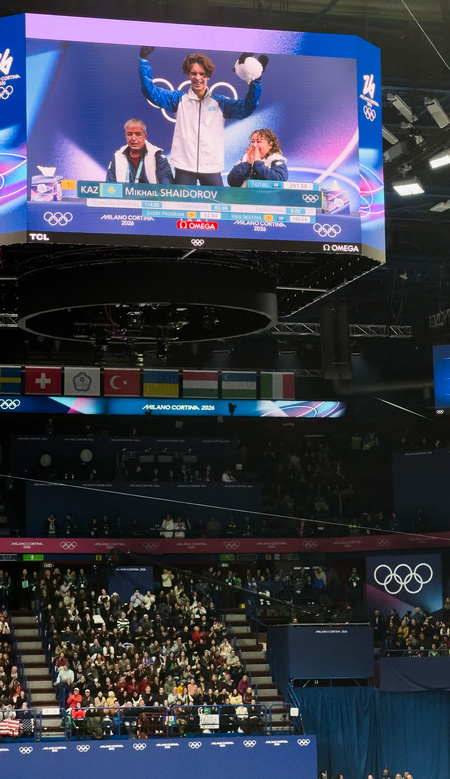
Two days after a short program that seemed to establish a logical order, Malinin leading, Kagiyama close, Shaidorov in contention, the free skate dismantled expectations. Rather than confirming hierarchy it exposed the Olympic truth, standings are provisional until the final blade mark. The segment did not simply decide medals, it transformed the narrative of the Games. Mikhail Shaidorov of Kazakhstan rose from fifth after the short program to Olympic Champion with a total of 291.58, delivering a free skate defined by control, technical clarity, and composure under maximum pressure.
What made this victory exceptional was not only execution but decision making under Olympic pressure. Mid program, with a triple flip originally planned, Shaidorov chose to upgrade the element to a quadruple flip. There was no visible hesitation, only crossover, crossover, and then the sudden elevation into a fully committed quad. That moment embodied competitive audacity. At the Olympic level, gold is not secured by caution but by the capacity to unite technical mastery with decisive risk. This was not recklessness, it was clarity, the choice of an athlete who understood he was skating not to defend placement but to win the Games. His layout combined five quadruple jumps with structural intelligence, including a quad–triple combination and the rare triple axel, Euler, quadruple salchow sequence, a combination that remains one of the most technically complex passes in the sport. Each element was integrated with control, preserving second half bonus value and maximizing scoring potential. His technical element score reached 114.68, a benchmark that defined the competitive ceiling of the night and created a margin that no late surge could close. Program components reflected the same authority, with skating skills, transitions, performance, composition, and interpretation all reinforcing the impression of a complete Olympic program rather than a collection of elements.
The performance unfolded to the music of Dimash, the Kazakh singer whose voice carries national resonance. Inside the arena the effect was unmistakable. The program did not feel like an upset in motion, it felt like the confirmation of a champion’s trajectory. From the beginning of the season this program had the structure and presence of an Olympic winning vehicle. In Milan it reached its full expression, technical ambition anchored by composure, musical interpretation aligned with identity, and pacing that never surrendered to pressure.
So, framing Shaidorov as an underdog ignores the depth of his career. He entered the Games as the reigning World silver medalist, already established among the elite and one of the few skaters with the technical capacity and competitive discipline to challenge Malinin. His ascent in Milan was not an anomaly but a culmination. For those who had followed his progression, the possibility of Olympic gold had been visible long before the final skate. He did not win because others faltered. He won because he delivered the most complete performance. He was the best skater that night.
The atmosphere inside the venue amplified that realization in real time. As scores from the final contenders were announced, Shaidorov’s placement evolved from provisional bronze to silver and finally to gold. The disbelief on his face mirrored the reaction of his team. Coach Alexei Urmanov, Olympic champion himself, stood at the boards witnessing the passage of Olympic legacy from one generation to the next. Choreographic guidance from Ivan Mesh and Ivan Righini shaped the program’s architecture, and the collective reaction of the coaching team reflected not surprise at the quality of the skate but awe at the magnitude of the moment. Shaidorov did not emerge from nowhere. He arrived fully formed, took the risk that defined the night, and delivered a program that will stand as one of the clearest demonstrations of how Olympic gold is truly won.
He not only made history as Kazakhstan’s first Olympic champion in men’s figure skating, he also carried forward a legacy shaped by Denis Ten, the first skater from Kazakhstan to stand on an Olympic podium, winning bronze at the 2014 Sochi Games, he opened a path that had never existed before in his country. But his impact went even further. Denis Ten invested in the future of skating in Kazakhstan, organizing international competitions in Almaty and mentoring younger athletes. He believed in building a system, not just a career. His tragic passing in 2018 transformed him into a symbol, not only of excellence, but of possibility.
So when Mikhail Shaidorov rose to Olympic gold, it was not an isolated victory. It felt like the continuation of a story Denis Ten had begun, a promise fulfilled, a standard elevated, and a legacy honored on the sport’s highest stage.

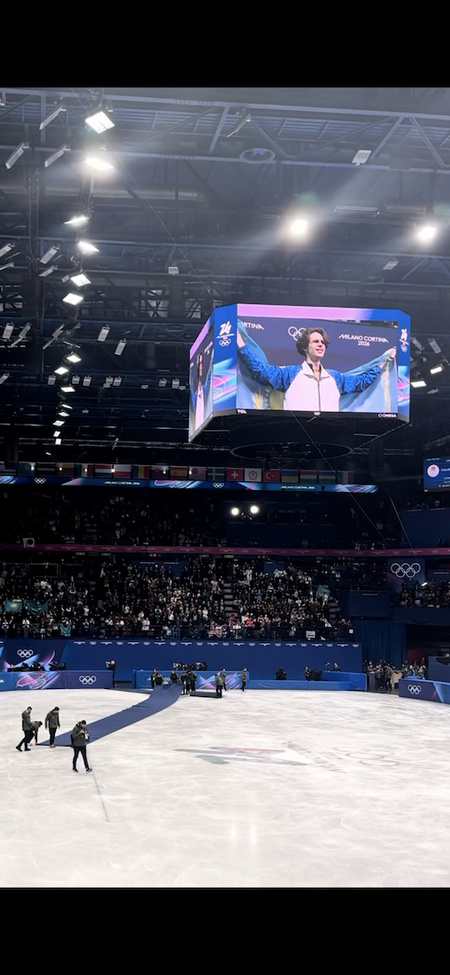
Ilia and Mikhail, an example of sportsmanship

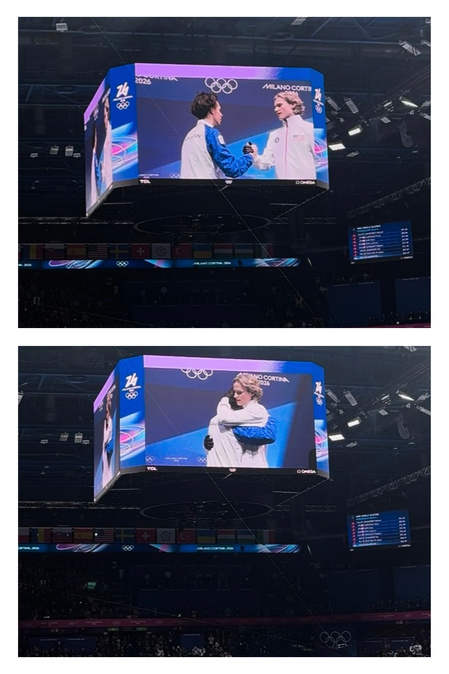
In the immediate aftermath of the men’s free skate in Milan, before the arena had fully processed the scale of what had just happened, one moment defined the spirit of the event. Ilia Malinin, the sport’s dominant force of the past three seasons, did not retreat into disappointment. Instead, he walked directly to Mikhail Shaidorov. They shook hands. They embraced.
It was instinctive, respectful, and deeply human. In a night marked by pressure, reversal, and historic consequence, the first reaction between the two men was recognition, not rivalry. Malinin, who had just endured one of the most brutal Olympic outcomes possible for a favorite, chose dignity. Shaidorov, who had just achieved the pinnacle of his sport, received that gesture with humility. This exchange mattered because it revealed the true culture of elite figure skating. Beneath the technical arms race of quads and base value, the sport remains grounded in mutual understanding. No one understands the cost of that ice better than the skaters themselves. They know the years of repetition behind a single jump, the invisible injuries, the psychological strain, the loneliness of preparation, and the razor edge between triumph and collapse. In that embrace, there was no narrative of upset or defeat. There was acknowledgement. Malinin recognizing that Shaidorov delivered the skate of his life. Shaidorov recognizing the champion he had just dethroned.
For a generation of young skaters watching, this moment may prove as important as the technical content of the programs. It showed that greatness is not measured only by medals, but by conduct under pressure. That respect does not weaken competition, it elevates it. That the Olympic stage, for all its ruthlessness, can still produce gestures of grace that endure longer than scores. Long after the protocols are archived and the numbers fade from memory, the image remains: two of the world’s best skaters, at the peak of their powers, choosing respect in the very moment when ego could have prevailed. That is sport. That is Olympic spirit.
Fact 5 — The Podium: Resilience, Comebacks, New Competitive Landscape And The Invisible Pressure Shaping Modern Olympic Skating

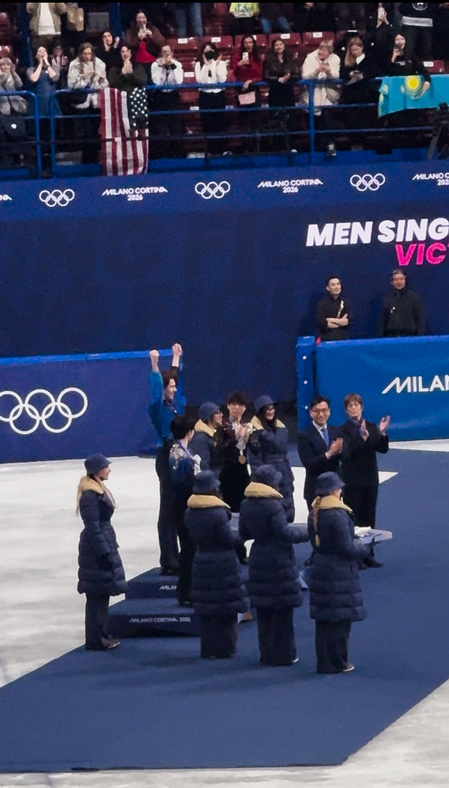
The Milan free skate demonstrated with unusual clarity that Olympic podiums are not awarded to the skater with the most spectacular theoretical ceiling, but to the one who preserves structure when the entire competitive ecosystem begins to fracture. Over the course of four minutes, the segment compresses years of preparation into a single, irreversible performance window in which resilience becomes measurable. Jumps are no longer isolated elements but pressure points in a fragile system where fatigue, timing, and confidence interact. The athletes who ultimately shaped the podium were those who managed risk rather than chased it, who understood when to protect combinations, when to preserve second-half value, and when to prioritize completion over escalation. In Milan, survival was not a fallback strategy, it was the winning one. The Olympic title was not awarded to theoretical difficulty, reputation, or expectation. It was claimed by the skater who united mastery, courage, identity, and composure across four minutes that allowed no correction.
Comebacks did not always take the form of dramatic climbs in placement. They appeared in quieter ways: in the restoration of composure after early instability, in the decision to continue fighting for every landing, in the refusal to allow one compromised element to contaminate the entire program. This form of competitive resilience defined the night. Skaters who absorbed pressure and recalibrated in real time preserved their scoring architecture, while those forced into improvisation saw the mathematical logic of their programs collapse. The free skate exposed a fundamental Olympic truth: recovery is not about returning to the original plan, but about safeguarding what remains when the plan begins to erode.
Olympic pressure itself acted as both magnifier and equalizer. It accelerated time perception, narrowed decision windows, and transformed instinct into conscious calculation. Elements that function automatically in training demanded active control. Takeoffs required commitment without hesitation, landings demanded trust in muscle memory, and transitions tested cardiovascular endurance at the precise moment fatigue set in. The psychological weight of the Games was visible in pacing, in the extra beat before entries, in the way athletes recalibrated risk mid-program. The Olympics do not introduce new technical requirements, but they alter the internal conditions under which those requirements must be met. In Milan, that altered condition reshaped the entire field.
The results also revealed a broader transformation in the competitive landscape of men’s skating. Traditional powerhouses remained present, yet the final standings reflected a sport no longer confined to historic centers of dominance. Emerging federations and athletes from diverse skating cultures demonstrated the capacity to contend at the highest level, not through imitation but through distinct technical identities and strategic clarity. This widening geography is not incidental. It reflects the globalization of coaching knowledge, choreography, and training methodologies, as well as the growing accessibility of high-level technical content. Milan did not introduce this shift, it confirmed it.
Addendum — The Invisible Pressure Shaping Modern Olympic Skating
Beyond medals and mathematics, the Milan final carried a message that resonated far beyond the ice: mental health matters. The men’s free skate unfolded not only as a technical contest but as a psychological crucible, revealing how modern Olympic competition extends beyond physical preparation into the realm of emotional endurance. In a discipline where timing, trust in muscle memory, and split-second commitment determine success, the mind is not separate from performance. It is the condition that makes performance possible. Equally significant was the generational context in which this Olympic final unfolded. Today’s skaters compete in an environment of constant visibility where performances are replayed, analyzed, and judged in real time across global platforms. The pressure is no longer confined to the arena. It extends into digital spaces where narratives form instantly and where athletes encounter both admiration and scrutiny at unprecedented speed. A fall becomes a clip. A mistake becomes a headline. A program becomes a meme before the athlete has even left the kiss and cry. In this environment, composure is not only a competitive asset, it is a survival skill.
What ultimately decided the podium in Milan was not a single jump, a single error, or a single moment. It was the cumulative ability to remain intact while the event unfolded in volatility. The skaters who prevailed did not eliminate risk, they contained it. They did not avoid pressure, they absorbed it. They did not rely on reputation, they constructed credibility in real time. This capacity to stay mentally present while the structure of a program is threatened has become as decisive as technical content.
Ilia Malinin spoke candidly after the event about the weight of Olympic pressure, the constant scrutiny, and the overwhelming flood of thoughts that accompanied his starting pose. His words reflected a reality shared by the new generation of skaters, athletes who compete not only before judges and audiences in the arena, but under the relentless gaze of global media, social platforms, and instant commentary. His description of memories and expectations rushing in at the moment of stillness before the music began revealed how the Olympic stage compresses personal history, public expectation, and technical demand into a single breath.
Today’s skaters perform in an environment where every element is replayed, dissected, and judged in real time. Praise is immediate, but so is criticism. Narratives are built within minutes, and athletes often encounter sensational headlines, reductive analysis, and, at times, cruel commentary that reduces complex performances to viral moments. The permanence of digital archives means that a single performance can follow an athlete for years, shaping perception in ways that extend far beyond the competition itself.
This constant exposure has become a new competitive parameter. Technical preparation remains essential, but psychological resilience must now extend beyond competition stress to include digital scrutiny and public perception. The Olympic stage magnifies this pressure, compressing years of expectation into a single performance window that unfolds before a global audience of millions. In such conditions, the ability to regulate emotion, maintain focus, and accept imperfection becomes part of the athletic skill set. Malinin’s openness did not weaken his stature. It humanized it. It reminded the sport that behind revolutionary technical ceilings are athletes navigating unprecedented visibility and emotional demands. In a night defined by resilience and reversals, his words became part of the event’s legacy, a call to recognize that sustaining excellence in modern figure skating requires not only physical mastery and technical innovation, but mental care, support systems, and a more responsible conversation around performance.
The final standings reflected precision under pressure rather than pre-event predictions.
Gold — Mikhail Shaidorov (KAZ)
A performance built on execution, strategic clarity, and composure under maximum pressure. His victory confirmed that Olympic titles are secured not by theoretical difficulty, but by the ability to preserve structure when the stakes are absolute.
Silver — Yuma Kagiyama (JPN)
A study in consistency, edge purity, and competitive maturity. His skating reaffirmed that refined fundamentals and disciplined execution remain decisive in quad-driven programs.
Bronze — Shun Sato (JPN)
An Olympic rise confirming Japan’s depth and the strength of disciplined technical skating. After the disappointment of the team event, his podium finish in the individual competition felt almost like destiny, a restoration of confidence under the highest stakes.
The podium did not reward risk alone. It rewarded control when the stakes were absolute.
The free skate did not only crown a champion. It reshuffled narratives across the field.
Stephen Gogolev (CAN) delivered one of the night’s defining performances, placing second in the free skate and sixth overall, a powerful statement from Canada’s next generation and a reminder that his junior-era technical brilliance has matured into senior-level impact.
Petr Gumennik (AIN), after navigating a last-minute music change before the short program, produced a fourth-place free skate to finish fifth overall. His performance combined technical assurance with composure under pressure, confirming his place among the sport’s emerging elite and demonstrating that adaptability has become a defining skill in modern Olympic skating.
Nika Egadze (GEO), fourth overall, continued Georgia’s ascent in men’s skating, proving that the sport’s competitive map is expanding beyond traditional powerhouses.
The result sheet told one story. The ice told another, one of resilience, reinvention, and the arrival of a broader global field.
Final Top 10 — Men’s Singles Overall
1. Mikhail Shaidorov (KAZ)
2. Yuma Kagiyama (JPN)
3. Shun Sato (JPN)
4. Nika Egadze (GEO)
5. Petr Gumennik (AIN)
6. Stephen Gogolev (CAN)
7. Adam Siao Him Fa (FRA)
8. Ilia Malinin (USA)
9. Junhwan Cha (KOR)
10. Daniel Grassl (ITA)
A performance built on execution, strategic clarity, and composure under maximum pressure. His victory confirmed that Olympic titles are secured not by theoretical difficulty, but by the ability to preserve structure when the stakes are absolute.
Silver — Yuma Kagiyama (JPN)
A study in consistency, edge purity, and competitive maturity. His skating reaffirmed that refined fundamentals and disciplined execution remain decisive in quad-driven programs.
Bronze — Shun Sato (JPN)
An Olympic rise confirming Japan’s depth and the strength of disciplined technical skating. After the disappointment of the team event, his podium finish in the individual competition felt almost like destiny, a restoration of confidence under the highest stakes.
The podium did not reward risk alone. It rewarded control when the stakes were absolute.
The free skate did not only crown a champion. It reshuffled narratives across the field.
Stephen Gogolev (CAN) delivered one of the night’s defining performances, placing second in the free skate and sixth overall, a powerful statement from Canada’s next generation and a reminder that his junior-era technical brilliance has matured into senior-level impact.
Petr Gumennik (AIN), after navigating a last-minute music change before the short program, produced a fourth-place free skate to finish fifth overall. His performance combined technical assurance with composure under pressure, confirming his place among the sport’s emerging elite and demonstrating that adaptability has become a defining skill in modern Olympic skating.
Nika Egadze (GEO), fourth overall, continued Georgia’s ascent in men’s skating, proving that the sport’s competitive map is expanding beyond traditional powerhouses.
The result sheet told one story. The ice told another, one of resilience, reinvention, and the arrival of a broader global field.
Final Top 10 — Men’s Singles Overall
1. Mikhail Shaidorov (KAZ)
2. Yuma Kagiyama (JPN)
3. Shun Sato (JPN)
4. Nika Egadze (GEO)
5. Petr Gumennik (AIN)
6. Stephen Gogolev (CAN)
7. Adam Siao Him Fa (FRA)
8. Ilia Malinin (USA)
9. Junhwan Cha (KOR)
10. Daniel Grassl (ITA)
Closing Insight
The Milan free skate did more than crown a champion. It revealed a sport in motion, where hierarchy can collapse in a single night, where new nations and history rise, and where resilience has become as decisive as technical mastery.