
“The sea is the same as it has been since before men ever went on it in boats.” — Ernest Hemingway


Wanderlust Ice & Ink — Life On Board: A Day in My Life Before Returning to a Cruise Ship as a Professional Pair Skater (c) Sarah Lepage.
Every time I prepare to return to a ship contract, I am reminded of something simple: no matter how many years I have spent performing professionally, I never consider any opportunity guaranteed. Perhaps it comes from the way I was raised, the way I grew up, and how sport was literally a school of life for me, or from spending most of my life in a profession where every opportunity must be earned. Whatever the reason, I have never viewed this career as something I am owed. More than ten years after signing my first professional contract, I still approach each new contract with the same excitement, gratitude, and sense of responsibility I felt at the beginning. One of the greatest lessons this profession has taught me is humility. In an industry built on auditions, constant evaluation, and ever-changing casts, there is always another skill to develop, another challenge to overcome, and another opportunity to earn. Returning to sea is never something I take for granted.
What many people see is the visible side of the profession: the performances, the destinations, the costumes, and the life on board. What often remains unseen is everything that happens beforehand. The weeks between contracts are not simply a break. They are a period of preparation where training resumes, physical conditioning is rebuilt, technical details are refined, and the body gradually readapts to the demands of performance. For me, this period is also a moment to reflect on how unlikely this journey truly was. Indeed, growing up in Saint-Nazaire, ships were part of the landscape long before they became part of my career. I grew up in a city shaped by shipbuilding, where ocean liners were not symbols of travel but part of everyday life. Looking back, I could never have imagined that one day I would perform aboard ships crossing the Caribbean, combining the profession I chose as a child with the maritime world that surrounded me growing up.
Even today, there is something surreal about that reality. Perhaps that is why every embarkation still feels special. Not because it represents another contract, but because it reminds me that some dreams take shape quietly, long before we fully understand them ourselves. Returning to a ship is not simply returning to work. It is returning to a profession that has accompanied me for most of my life and continues to challenge me, inspire me, and push me forward. Before the rehearsals begin, before the costumes, the lights, and the performances, there is this quieter chapter of preparation. A period dedicated to training, reflection, and getting ready to step back into a world I genuinely love.
This article offers a glimpse into that chapter and into what life looks like before returning to sea as a professional pair skater.
What many people see is the visible side of the profession: the performances, the destinations, the costumes, and the life on board. What often remains unseen is everything that happens beforehand. The weeks between contracts are not simply a break. They are a period of preparation where training resumes, physical conditioning is rebuilt, technical details are refined, and the body gradually readapts to the demands of performance. For me, this period is also a moment to reflect on how unlikely this journey truly was. Indeed, growing up in Saint-Nazaire, ships were part of the landscape long before they became part of my career. I grew up in a city shaped by shipbuilding, where ocean liners were not symbols of travel but part of everyday life. Looking back, I could never have imagined that one day I would perform aboard ships crossing the Caribbean, combining the profession I chose as a child with the maritime world that surrounded me growing up.
Even today, there is something surreal about that reality. Perhaps that is why every embarkation still feels special. Not because it represents another contract, but because it reminds me that some dreams take shape quietly, long before we fully understand them ourselves. Returning to a ship is not simply returning to work. It is returning to a profession that has accompanied me for most of my life and continues to challenge me, inspire me, and push me forward. Before the rehearsals begin, before the costumes, the lights, and the performances, there is this quieter chapter of preparation. A period dedicated to training, reflection, and getting ready to step back into a world I genuinely love.
This article offers a glimpse into that chapter and into what life looks like before returning to sea as a professional pair skater.
 New Recording 14.mp3 (4.87 Mo)
Performing on Cruise Ships

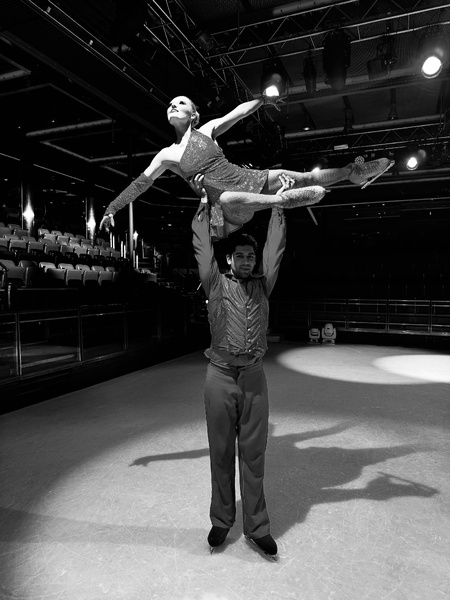
Performing on a cruise ship is a very specific environment that differs significantly from traditional arenas, theaters, or touring productions. While audiences often focus on the destinations or the uniqueness of seeing an ice rink at sea, the reality behind the profession is considerably more complex. Cruise ship productions represent one of the few environments in the world where professional figure skaters can perform full-scale ice shows year-round while traveling internationally. Cruise Companies, have developed permanent ice theaters at sea, allowing casts to present productions that combine technical skating, theatrical storytelling, aerial elements, advanced lighting systems, projection technology, and large-scale stage effects.
What makes this environment particularly demanding is the combination of performance quality and repetition. Unlike a competition, where athletes prepare for a single event, or a touring production, where schedules and venues constantly change, cruise ship performers are expected to deliver the same level of quality week after week, sometimes for contracts lasting several months. The challenge is not producing one exceptional performance. The challenge is producing that performance consistently. A guest attending a show on the final week of a contract deserves the same experience as a guest attending during the opening weeks. Maintaining that standard requires physical conditioning, technical precision, injury prevention, and a level of professionalism that extends far beyond the performance itself.
For pair skaters, the demands become even more specific. Every lift, throw, twist, and death spiral relies on timing, trust, and consistency between two individuals. Unlike solo disciplines, pair skating requires two athletes to function almost as a single unit. Small variations in timing, strength, fatigue, or positioning can affect the execution of an element. Maintaining that level of synchronization through repeated performances week after week requires constant communication and continuous training.
What makes this environment particularly demanding is the combination of performance quality and repetition. Unlike a competition, where athletes prepare for a single event, or a touring production, where schedules and venues constantly change, cruise ship performers are expected to deliver the same level of quality week after week, sometimes for contracts lasting several months. The challenge is not producing one exceptional performance. The challenge is producing that performance consistently. A guest attending a show on the final week of a contract deserves the same experience as a guest attending during the opening weeks. Maintaining that standard requires physical conditioning, technical precision, injury prevention, and a level of professionalism that extends far beyond the performance itself.
For pair skaters, the demands become even more specific. Every lift, throw, twist, and death spiral relies on timing, trust, and consistency between two individuals. Unlike solo disciplines, pair skating requires two athletes to function almost as a single unit. Small variations in timing, strength, fatigue, or positioning can affect the execution of an element. Maintaining that level of synchronization through repeated performances week after week requires constant communication and continuous training.


What I personally find most fascinating about cruise ship performance is the balance it requires. It combines the discipline of elite sport, the artistry of live theater, the technical precision of large-scale production, and the adaptability required by life at sea. There is often a misconception that working on a cruise ship resembles an extended holiday. While performers are fortunate to visit extraordinary destinations and travel extensively, the reality is that these experiences take place within a professional environment governed by schedules, responsibilities, rehearsals, safety procedures, and performance expectations. In many ways, cruise ship skating represents one of the most complete forms of professional performance. It requires athletic ability, artistic expression, reliability, teamwork, adaptability, and the capacity to deliver under changing conditions day after day.
Indeed, the environment itself introduces additional challenges. Although audiences may not notice it, performers are skating on a moving vessel. The motion of the ship can vary depending on weather conditions, sea state, speed, and route. While modern stabilization systems significantly reduce movement, skaters still learn to adapt their balance, spatial awareness, and timing to changing conditions. On some days, the differences are barely noticeable. On others, they become an additional factor that performers must constantly account for while executing technically demanding elements at high speed.
Another aspect rarely discussed is the physical reality of living and working onboard. Unlike athletes who return home after training, performers live within the same environment in which they work. Training sessions, rehearsals, performances, safety responsibilities, meetings, and daily life all take place within the same ecosystem. Learning how to balance performance demands with recovery becomes essential for maintaining long-term consistency throughout a contract. The professional standards expected of cruise ship casts are equally high. Many performers come from competitive skating backgrounds, international touring productions, professional ice shows, circus arts, dance, or other specialized disciplines. Audition processes are highly selective, and performers often undergo extensive rehearsals before ever stepping onboard. By the time a production reaches its audience, hundreds of hours of preparation have already taken place behind the scenes.
Indeed, the environment itself introduces additional challenges. Although audiences may not notice it, performers are skating on a moving vessel. The motion of the ship can vary depending on weather conditions, sea state, speed, and route. While modern stabilization systems significantly reduce movement, skaters still learn to adapt their balance, spatial awareness, and timing to changing conditions. On some days, the differences are barely noticeable. On others, they become an additional factor that performers must constantly account for while executing technically demanding elements at high speed.
Another aspect rarely discussed is the physical reality of living and working onboard. Unlike athletes who return home after training, performers live within the same environment in which they work. Training sessions, rehearsals, performances, safety responsibilities, meetings, and daily life all take place within the same ecosystem. Learning how to balance performance demands with recovery becomes essential for maintaining long-term consistency throughout a contract. The professional standards expected of cruise ship casts are equally high. Many performers come from competitive skating backgrounds, international touring productions, professional ice shows, circus arts, dance, or other specialized disciplines. Audition processes are highly selective, and performers often undergo extensive rehearsals before ever stepping onboard. By the time a production reaches its audience, hundreds of hours of preparation have already taken place behind the scenes.
Pair Skating and Pre Contract Preparation System

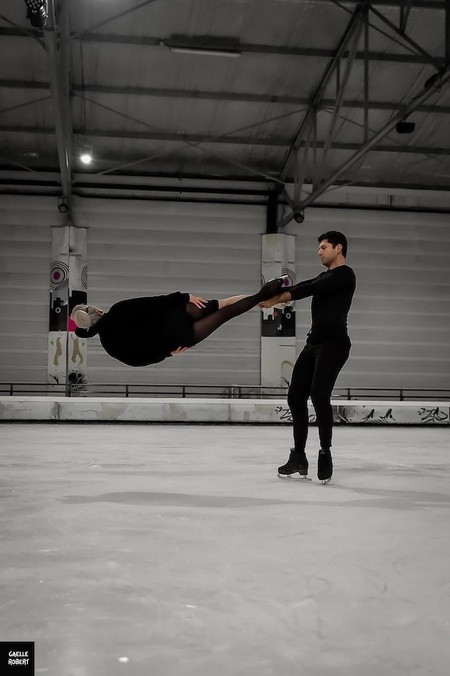
Far from being a break from the profession, it is one of its most demanding expressions. Behind every show lies a carefully structured system built on preparation, consistency, and the collective effort of performers, technicians, stage managers, and crew members working together to create an experience that lasts less than an hour but requires months, and often years, of preparation.
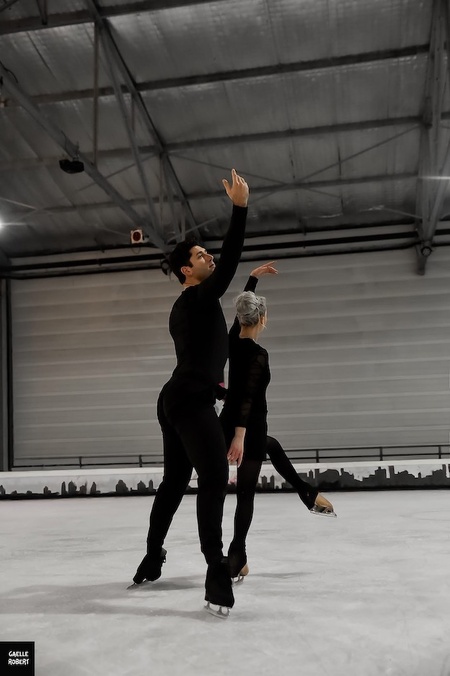
Pair skating is one of the most demanding disciplines in figure skating, both technically and physically. It is based on synchronization, trust, and precision, where two individuals must function as a single unit on the ice. Unlike solo skating, where control is entirely individual, pair skating requires constant adjustment to another body, another timing, and another interpretation. Before returning to the ship, this work becomes essential. My partner comes to train with me prior to each contract in order to rebuild and refine our programs. This preparation phase is not optional. It is a necessary step to ensure that every element is reliable, safe, and consistent before stepping back into a performance environment where there is no room for hesitation. Pair skating relies on extremely precise timing. Every entry, every transition, and every element must be aligned. Even a slight delay or misalignment can affect the entire sequence. This is particularly true in lifts, throws, and death spirals, where both partners depend on each other for execution and safety. These elements cannot be improvised or adjusted in real time without prior preparation.
Pair skating is one of the most demanding disciplines in figure skating, both technically and physically. It is based on synchronization, trust, and precision, where two individuals must function as a single unit on the ice. Unlike solo skating, where control is entirely individual, pair skating requires constant adjustment to another body, another timing, and another interpretation. Before returning to the ship, this work becomes essential. My partner comes to train with me prior to each contract in order to rebuild and refine our programs. This preparation phase is not optional. It is a necessary step to ensure that every element is reliable, safe, and consistent before stepping back into a performance environment where there is no room for hesitation. Pair skating relies on extremely precise timing. Every entry, every transition, and every element must be aligned. Even a slight delay or misalignment can affect the entire sequence. This is particularly true in lifts, throws, and death spirals, where both partners depend on each other for execution and safety. These elements cannot be improvised or adjusted in real time without prior preparation.
Adagio Skating

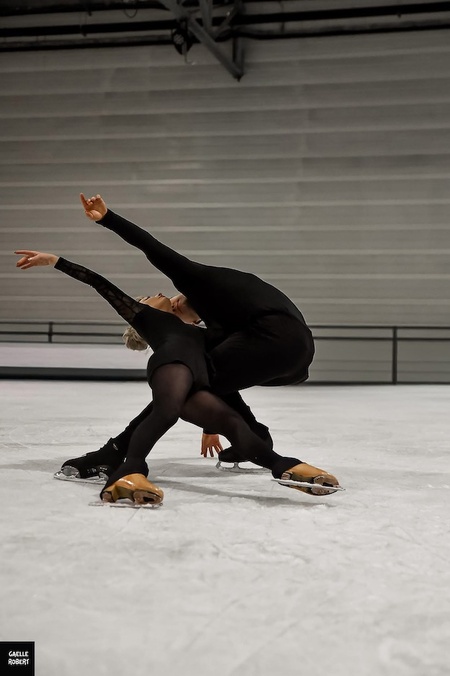
A central component of our work is adagio. Adagio refers to the slow, controlled part of pair skating, often built around lifts, holds, and transitions that require strength, stability, and fluidity. It is one of the most physically demanding aspects of the discipline. Unlike dynamic elements such as throws or spins, adagio requires sustained control, often holding positions for extended periods while maintaining clean lines and uninterrupted flow. This work demands a high level of upper body strength, core stability, and balance, particularly for the lifting partner, but also for the flyer, who must maintain precise body positions and tension throughout each movement. Beyond strength, adagio requires complete trust. The flyer must rely entirely on the partner’s control, while the base must anticipate and adjust continuously. Training this aspect before returning to the ship is fundamental. On board, performances follow a fixed schedule, often with multiple shows per week. There is limited time for technical adjustments once the contract begins. The body must already be conditioned, the timing already established, and the connection already rebuilt. Pre-ship training allows us to correct details, refine transitions, and ensure that every movement is consistent under performance conditions. Pair skating is also about non-verbal communication. Over time, partners develop a shared understanding that goes beyond verbal cues. Small adjustments, shifts in weight, or changes in timing are felt rather than spoken.
This connection can only be maintained through regular training. After time apart, it must be reactivated and strengthened. Working together again before the contract allows us to rebuild that connection. It ensures that we move with the same intention, the same rhythm, and the same level of control. It also reinforces safety, which remains a priority in every element we perform. In a professional environment, there is no space for uncertainty. The audience sees fluidity, ease, and synchronization. What they do not see is the preparation required to achieve it. Pair skating at this level is not simply about performing together. It is about preparing together, precisely and consistently, before stepping on stage.
This connection can only be maintained through regular training. After time apart, it must be reactivated and strengthened. Working together again before the contract allows us to rebuild that connection. It ensures that we move with the same intention, the same rhythm, and the same level of control. It also reinforces safety, which remains a priority in every element we perform. In a professional environment, there is no space for uncertainty. The audience sees fluidity, ease, and synchronization. What they do not see is the preparation required to achieve it. Pair skating at this level is not simply about performing together. It is about preparing together, precisely and consistently, before stepping on stage.

The transition between land and sea

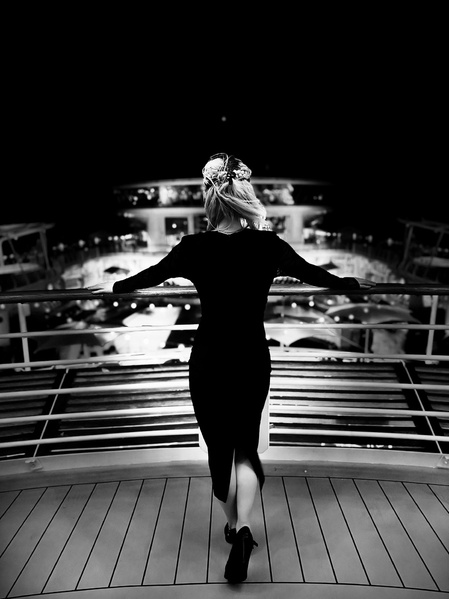
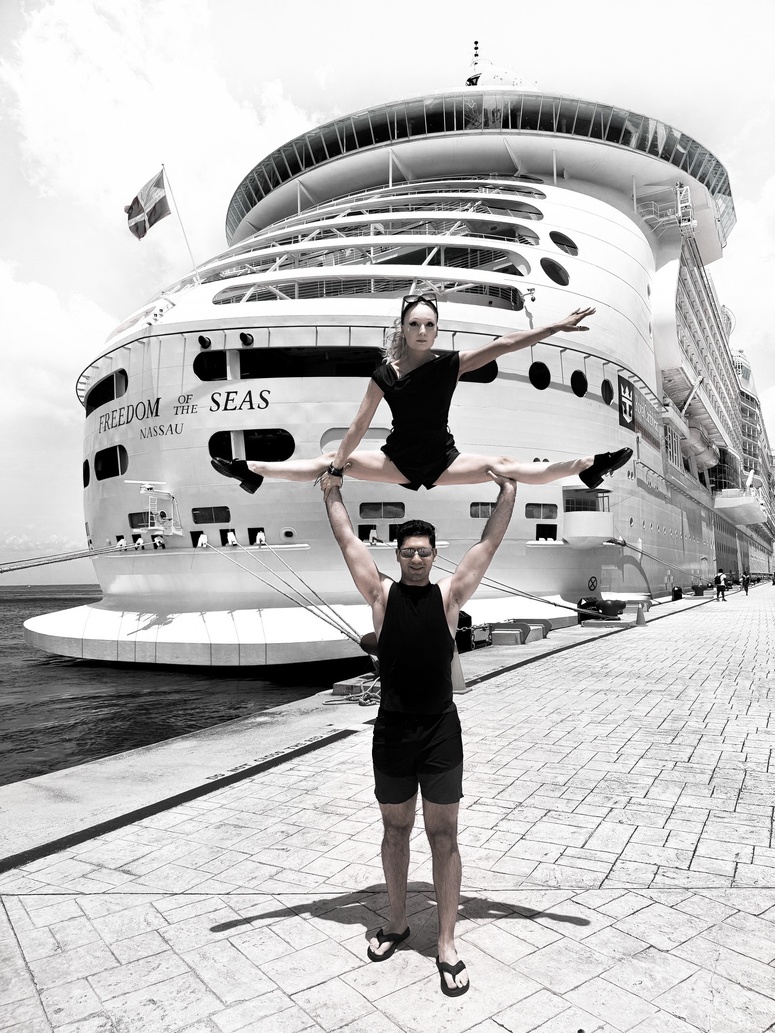
Every return to sea also involves a different kind of preparation, one that has little to do with training and everything to do with adaptation. Life on a cruise ship operates according to its own rhythm. For several weeks, or sometimes months, the ship becomes both home and workplace. The familiar routines of life on land gradually give way to a completely different environment, one shaped by performance schedules, rehearsals, safety procedures, crew life, and the constant presence of the ocean.
After spending time at home, there is always a transition period. Daily habits change, personal routines are reorganized, and familiar surroundings are replaced by a floating city that never truly stops moving. Within a matter of days, a morning coffee at home becomes breakfast with colleagues from different countries, familiar streets become ocean horizons, and everyday life begins to revolve around the rhythm of the ship. What I have always found fascinating about this lifestyle is how quickly that transformation happens. One week, I am training at my home rink, working on personal projects, writing articles, and enjoying time with friends. The next, I am living and performing alongside cast members and crew representing dozens of nationalities, all working together toward the same objective.
Perhaps that is one of the most unique aspects of performing at sea. Beyond the shows themselves, it is the opportunity to become part of a truly international community. Every contract brings new conversations, new perspectives, and new experiences. As both a performer and a journalist, I have always been fascinated by people, cultures, and the stories that connect them, and life on board offers a constant reminder of how diverse and interconnected the world can be. With experience, these transitions become easier, but they never lose their significance. Each embarkation still feels like stepping into a new chapter. The environment may be familiar, yet every contract carries its own energy, challenges, and opportunities. That balance between familiarity and discovery is part of what continues to make life at sea so rewarding, even after years in the profession.
After spending time at home, there is always a transition period. Daily habits change, personal routines are reorganized, and familiar surroundings are replaced by a floating city that never truly stops moving. Within a matter of days, a morning coffee at home becomes breakfast with colleagues from different countries, familiar streets become ocean horizons, and everyday life begins to revolve around the rhythm of the ship. What I have always found fascinating about this lifestyle is how quickly that transformation happens. One week, I am training at my home rink, working on personal projects, writing articles, and enjoying time with friends. The next, I am living and performing alongside cast members and crew representing dozens of nationalities, all working together toward the same objective.
Perhaps that is one of the most unique aspects of performing at sea. Beyond the shows themselves, it is the opportunity to become part of a truly international community. Every contract brings new conversations, new perspectives, and new experiences. As both a performer and a journalist, I have always been fascinated by people, cultures, and the stories that connect them, and life on board offers a constant reminder of how diverse and interconnected the world can be. With experience, these transitions become easier, but they never lose their significance. Each embarkation still feels like stepping into a new chapter. The environment may be familiar, yet every contract carries its own energy, challenges, and opportunities. That balance between familiarity and discovery is part of what continues to make life at sea so rewarding, even after years in the profession.

As I prepare to return to the ship, there is a sense of familiarity in the process. The training sessions are nearly complete, the skates are packed, the routines are established, and soon the focus will shift entirely to rehearsals and performances. Yet after all these years, embarkation day never feels ordinary. Perhaps it is because I know how much work takes place before that moment. Or perhaps it is because I never quite lose sight of how fortunate I am to do this profession. Growing up surrounded by ships, I could never have imagined that one day they would become part of my everyday life.
The audience will only see the finished result. The performances, the costumes, the music, and the moments that unfold under the lights. What remains invisible are the weeks of preparation, the hours spent on the ice, the conditioning, the adjustments, and the countless small details that make those performances possible. In many ways, that is the nature of this profession. The work happens long before the curtain rises.
And so, as one chapter comes to a close and another begins, I return to sea with the same mindset that has guided me throughout my career: gratitude for the opportunity, respect for the work it requires, and excitement for everything that still remains to be learned. The ship departs. The lights come on. The audience takes their seats. And once again, the journey continues.
The audience will only see the finished result. The performances, the costumes, the music, and the moments that unfold under the lights. What remains invisible are the weeks of preparation, the hours spent on the ice, the conditioning, the adjustments, and the countless small details that make those performances possible. In many ways, that is the nature of this profession. The work happens long before the curtain rises.
And so, as one chapter comes to a close and another begins, I return to sea with the same mindset that has guided me throughout my career: gratitude for the opportunity, respect for the work it requires, and excitement for everything that still remains to be learned. The ship departs. The lights come on. The audience takes their seats. And once again, the journey continues.


 Wanderlust Ice & Ink – Life On Board as a Pair Figure Skater And Lifestyle Journalist on a Cruise Ship: Article 1 | Introduction to the Series